Order
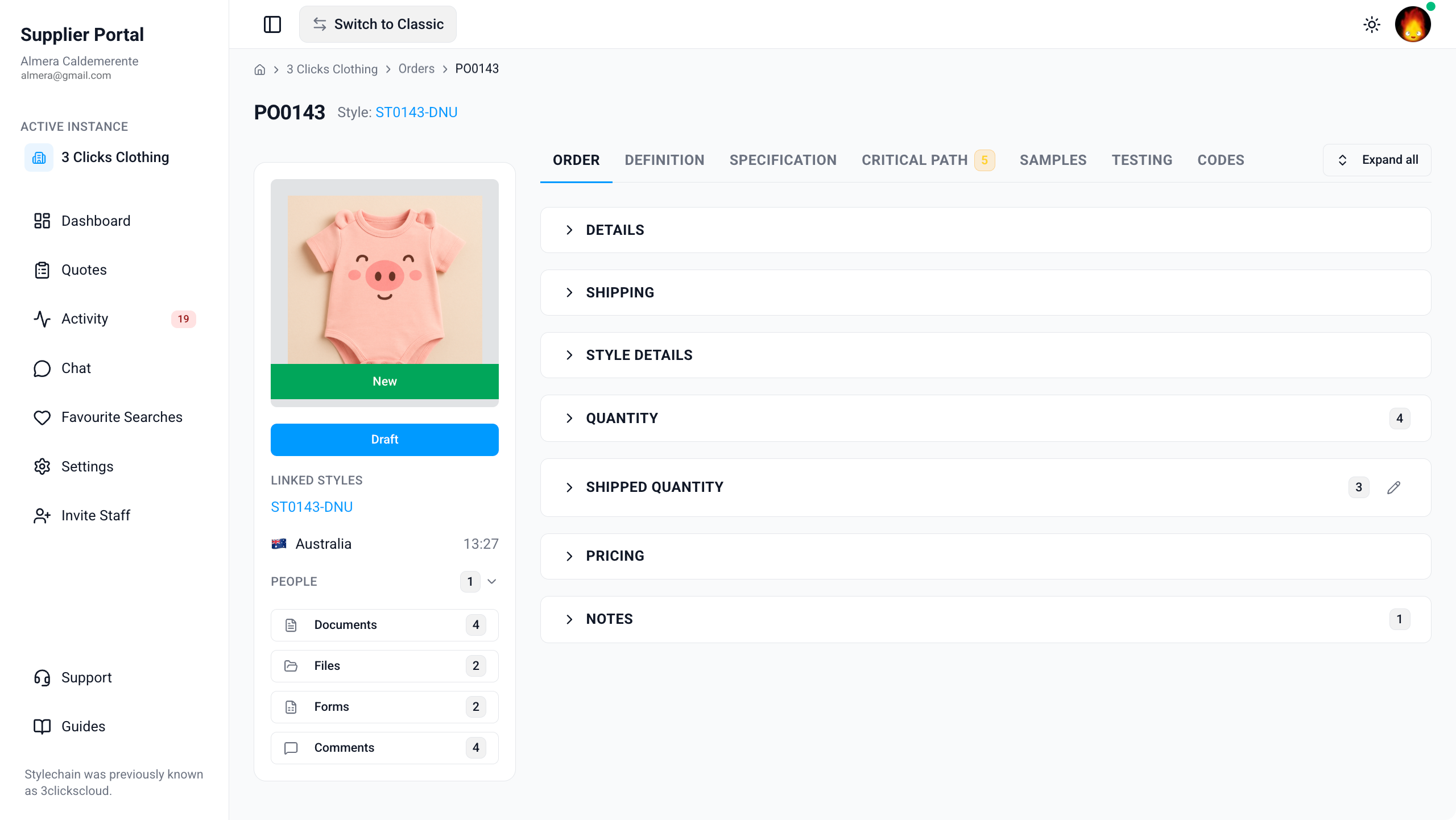
The Order record in the Supplier Portal is where you review purchase order information your customer has shared with your supplier account. It brings together Details, Shipping, Style Details, Quantity, Shipped Quantity, Pricing, and Notes in one view so you can confirm order attributes, colourway quantities, commercial values, and shipment progress before production and dispatch.
The order card also includes side widgets for preview images, status, documents, files, forms, and collaboration context. Most fields in these sections are view-only. Your customer may enable Shipped Quantity editing so you can record actual dispatch quantities against the order.
Quick Check - Before You Start
- See Supplier Portal › Orders for search, filters, and export.
- Confirm you are on the correct customer connection in Active Instance if you work with more than one brand.
- If sections are missing or empty, ask your instance user to verify the order is shared with your factory or agent and that your Supplier Portal role includes Order View access.
- Order pricing visibility is controlled separately in Site Settings › Portal › General Settings › Order — some price types may be hidden by design.
View-Only Access by Default
The Details, Shipping, Style Details, Quantity, Pricing, and Notes sections in the Supplier Portal are read-only. Instance users create and update order data in the Production Portal. You can reply in Comments when your customer has shared the order with your account. Shipped Quantity may be editable when your customer enables supplier quantity entry in Site Settings › Shipping › General Settings › Shipped Quantity.
Side Widgets
The order includes side widgets that give quick context and access to shared files and documents.
| Widget | Description |
|---|---|
| Image Preview | Displays the style preview image linked to the order. Use it to identify the product at a glance. 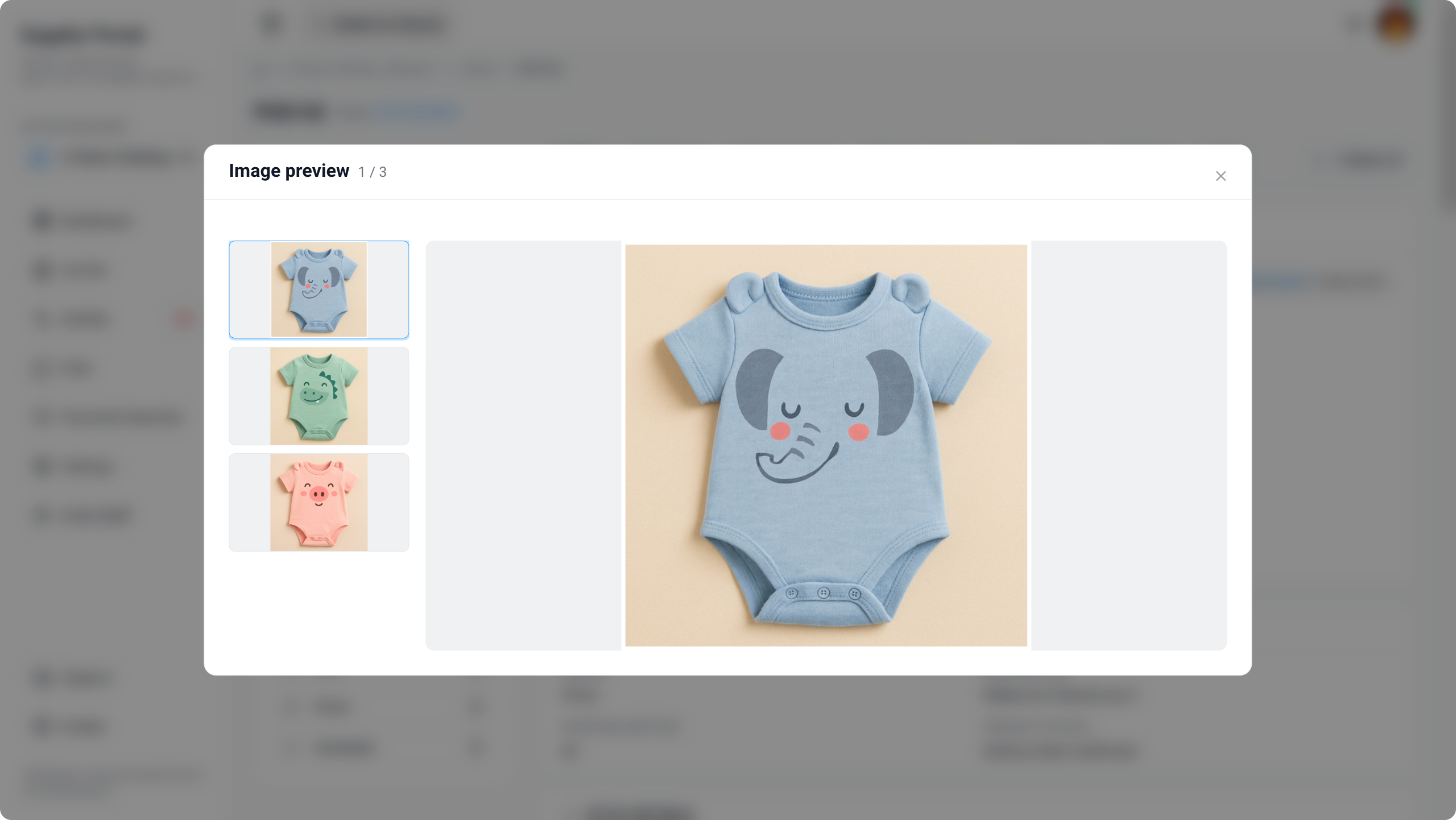 |
| Label | Shows labels your customer has applied to the order for filtering and visual identification. |
| Status | Displays the current order status (for example, In Progress, Completed, or Stopped). |
| Linked Styles | Lists styles associated with the order. Each style number is clickable when that style is also shared with your supplier account on the same customer connection. |
| Country and Time | Shows the country of the instance user viewing or managing the order, together with their current local time in their own timezone. Use this when coordinating ex-factory dates or shipment hand-offs across regions. |
| People | Lists the instance users who are members of this order. These are your customer's internal contacts assigned to the record — not supplier staff accounts. |
| Documents | Provides downloadable copies of formal order outputs when your customer has generated them, including Purchase Order, Specification, Test Summary, and Sample Request documents. 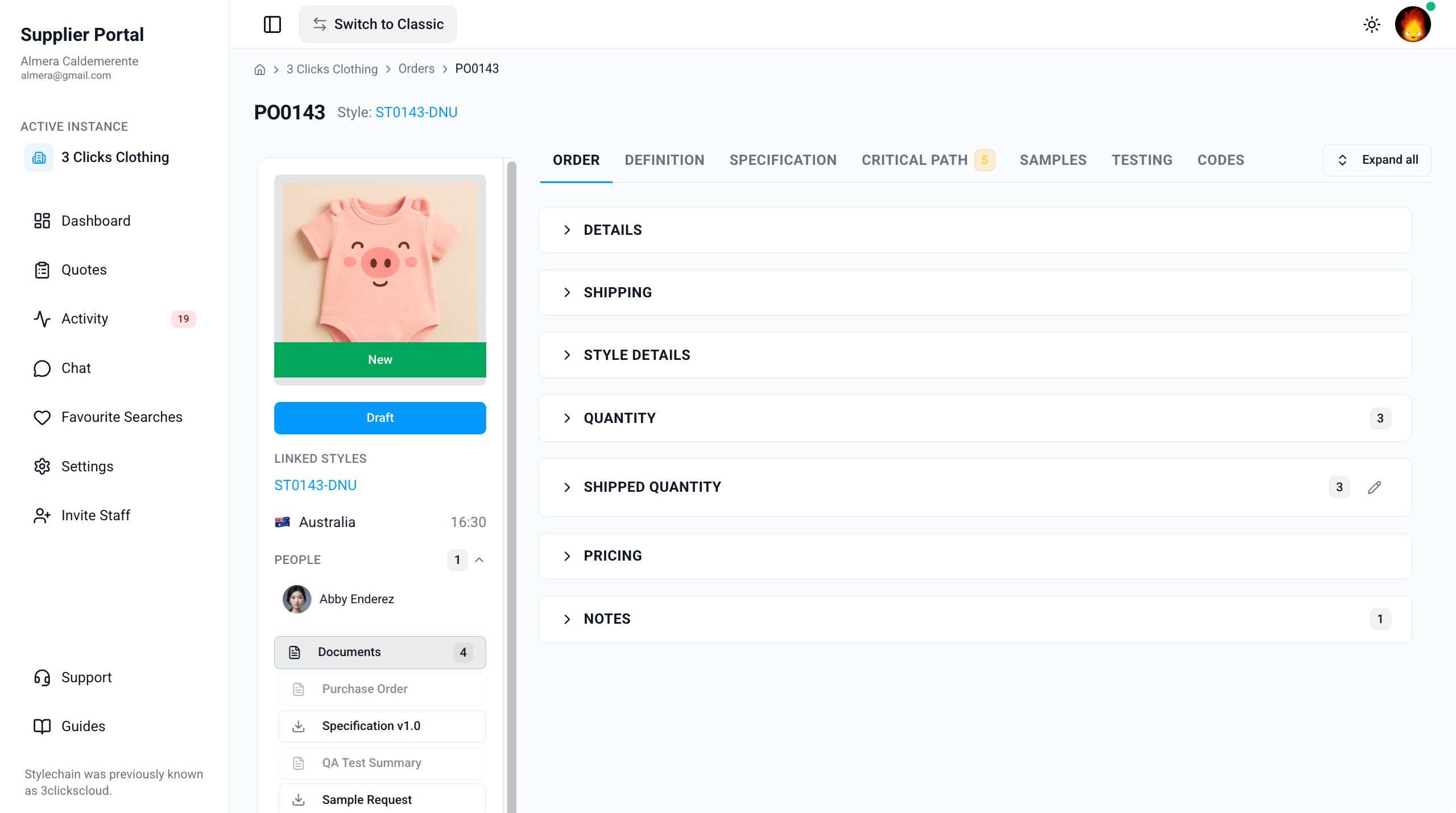 |
| Files | Opens the Files pop-up, where you can browse uploaded files and folders for the order. Files here are downloadable when your customer has shared them with your supplier account. 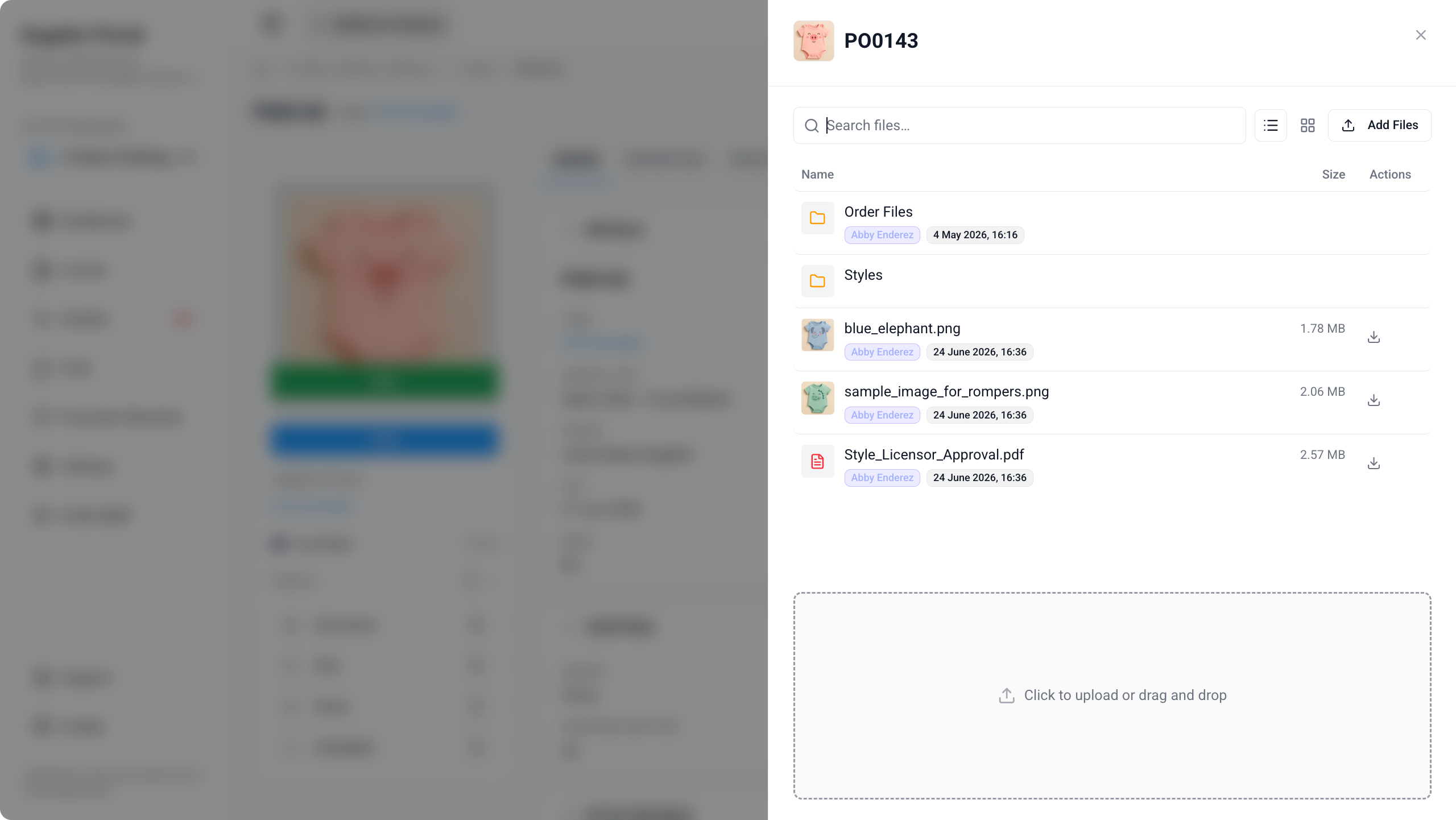 |
| Forms | Opens order forms your customer has configured for supplier completion or review, when portal forms are enabled on the order. 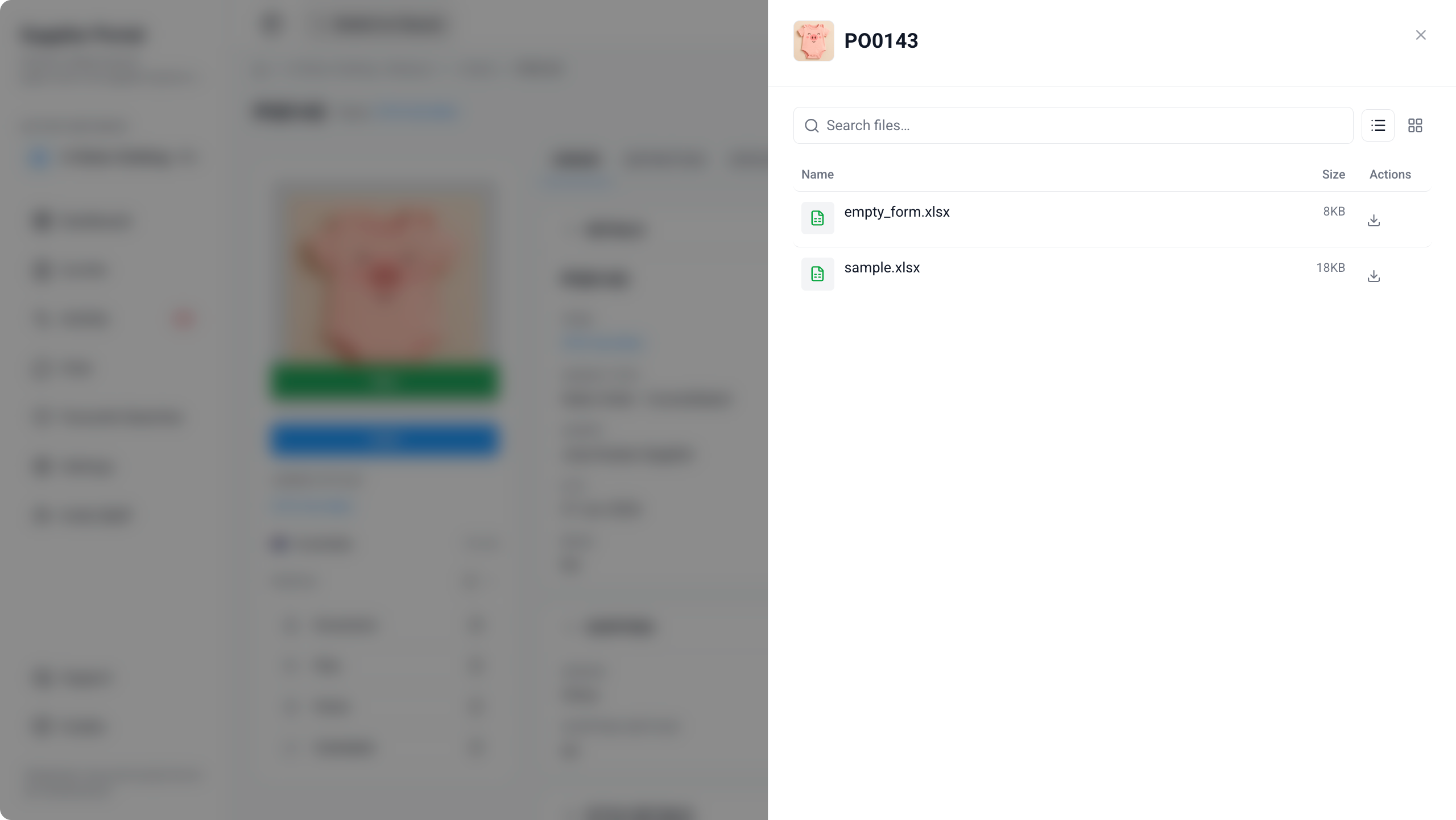 |
| Comments | Lets you read and reply to messages from your customer's team on the order record. Use Comments for questions about quantities, dates, or specifications. 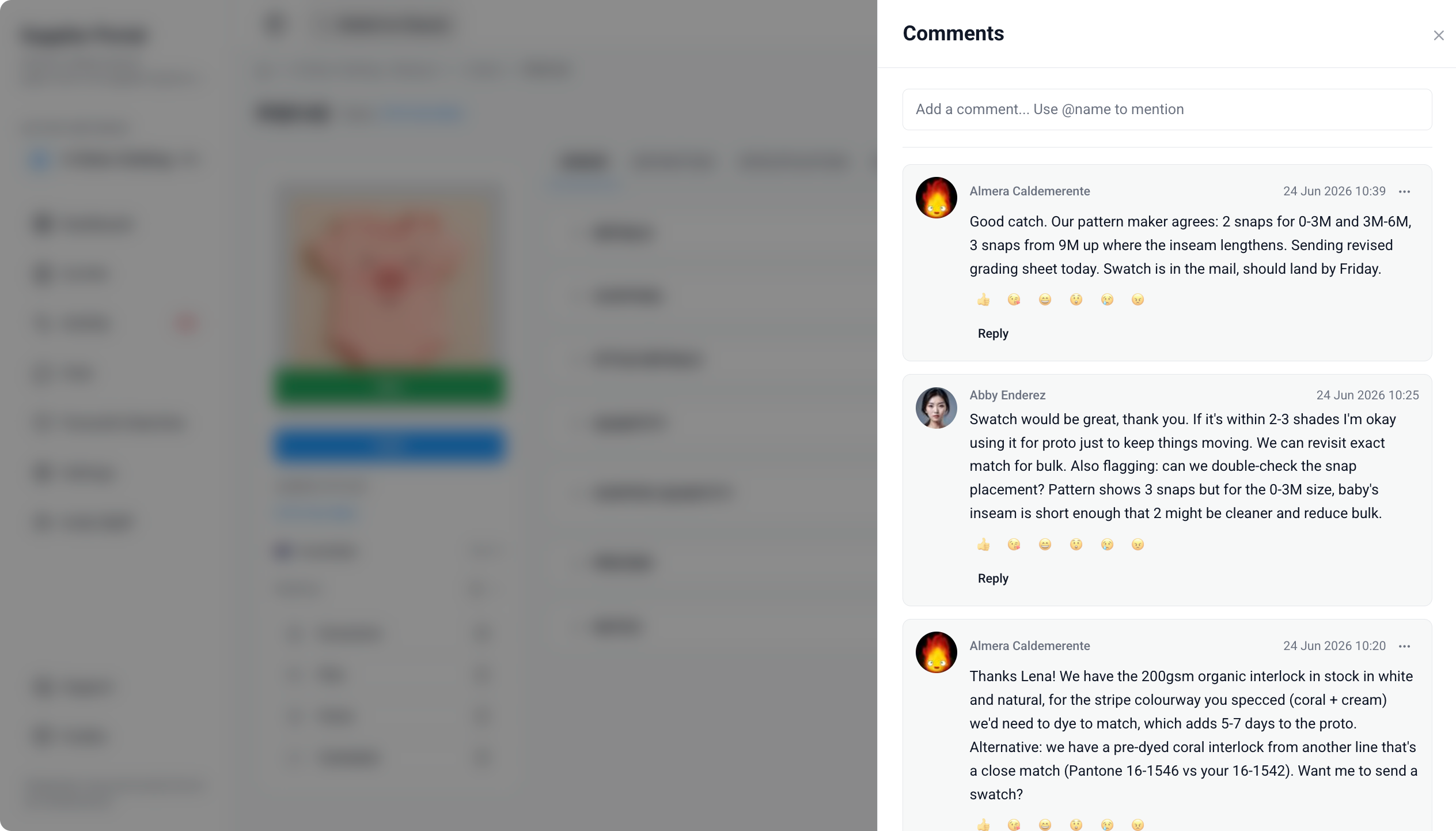 |
Details
The Details section is view-only. It displays core order information your customer's instance users maintain on the Production Portal.
At the top of the section, the order number, linked item (style number), Created By, and creation date stamp help you confirm you are reviewing the correct record.
Supplier Portal > Order > Details 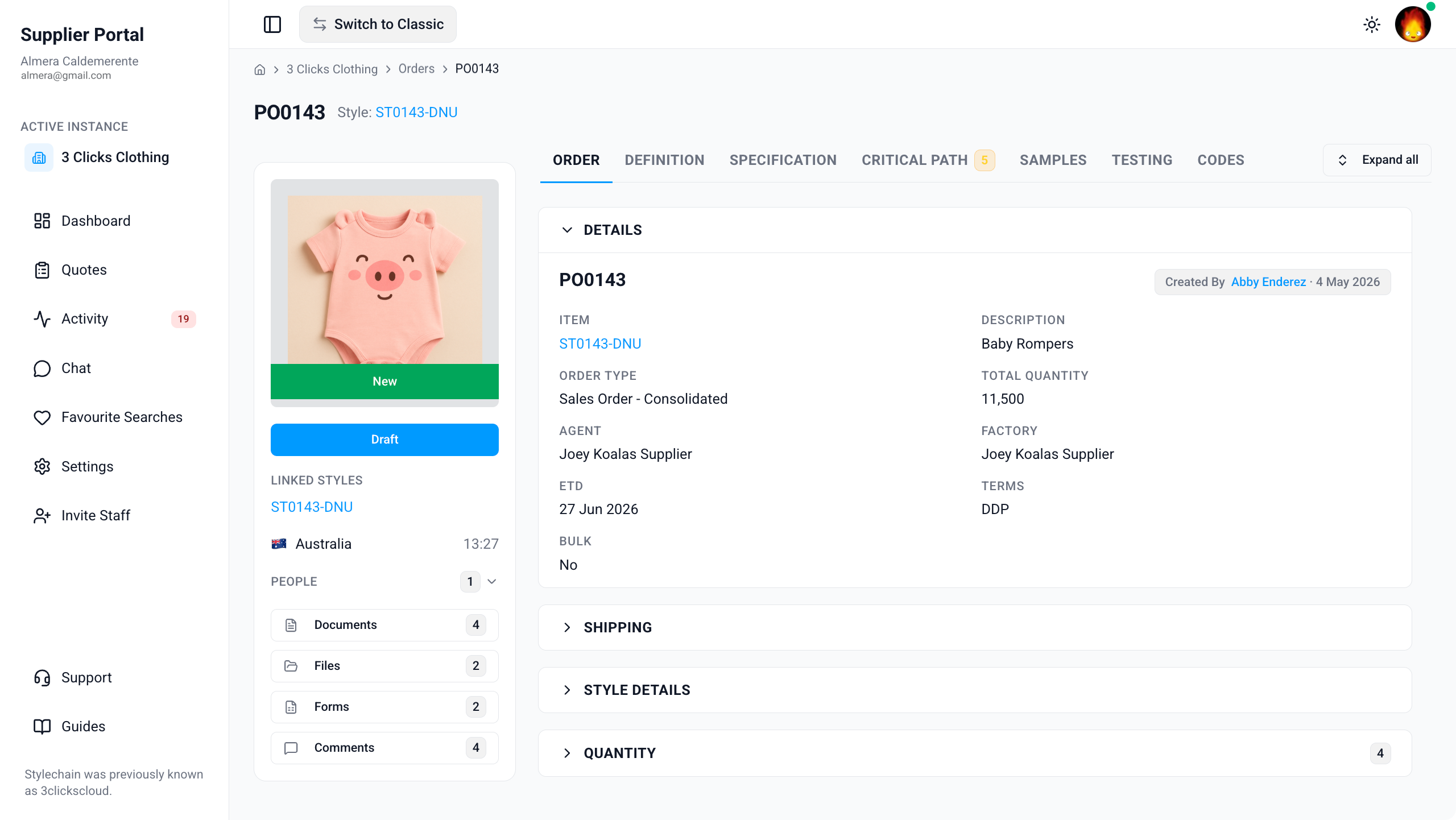
| Field | Description |
|---|---|
| Order No. | The unique order identifier assigned by your customer's system. |
| Item (Style No.) | The style number linked to the order. |
| Description | A brief description of the order or product. |
| Order Type | The classification of the order (for example, Production, Sample, or bulk order types). |
| Total Quantity | The total ordered quantity across all colourways and sizes on the order. |
| Agent | The agent supplier assigned to help coordinate the order. |
| Factory | The factory supplier assigned to manufacture the order. |
| ETD | Estimated time of departure — when goods are expected to leave the origin. May also appear on the order search view when your customer enables supplier date editing. |
| Terms | The commercial terms applied to the order (for example, payment or delivery terms). |
| Bulk | Indicates whether the order is a bulk-style order (Yes or No). |
Confirm Your Assignment
You only see orders your customer has shared with your supplier account and assigned to your organisation as the Factory or Agent. If a field looks incorrect, contact your instance user because you cannot edit Details directly in the Supplier Portal.
Shipping
The Shipping section is view-only. It displays logistics information your customer's instance users maintain for the order.
Supplier Portal > Orders > Shipping 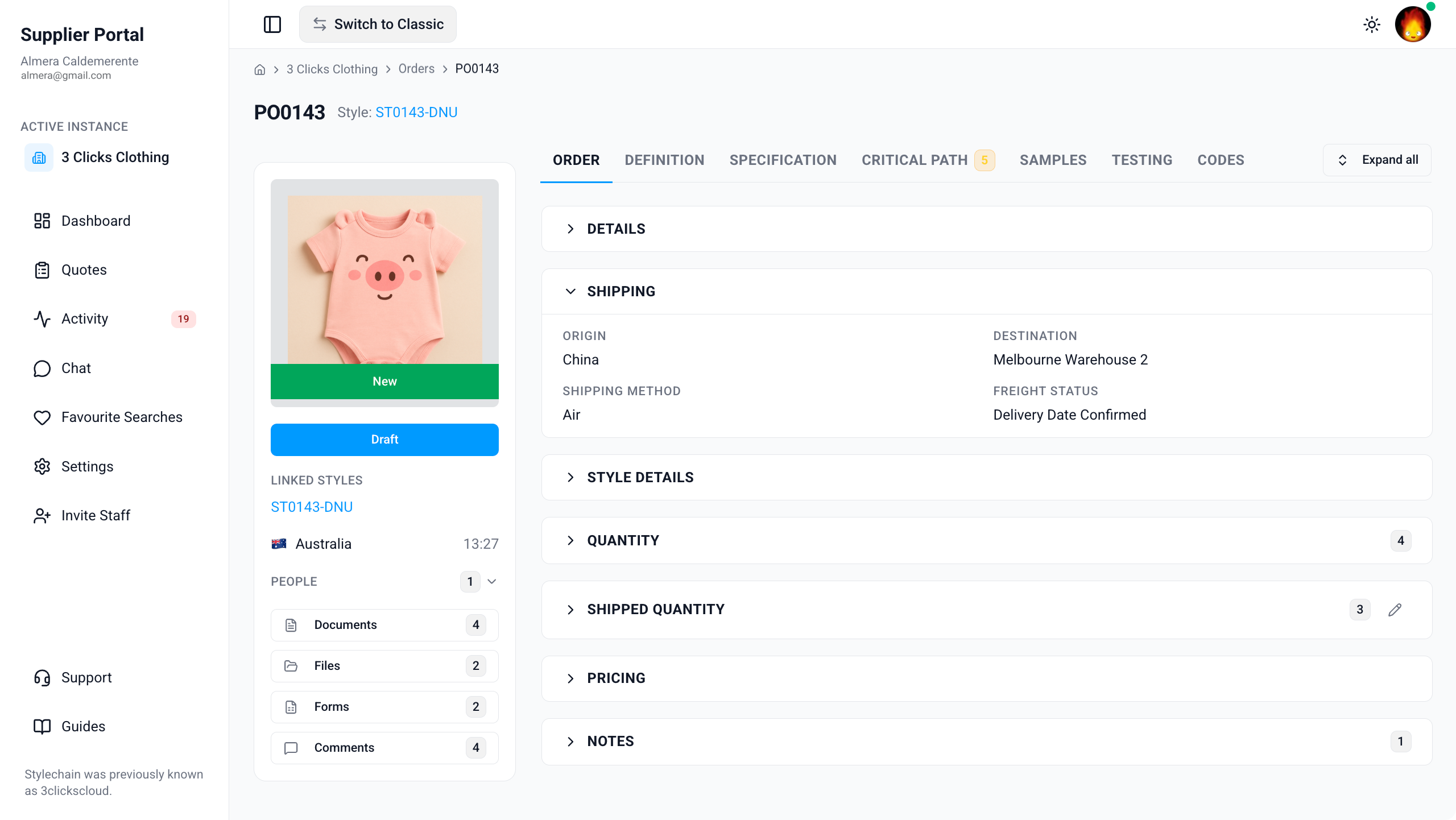
| Field | Description |
|---|---|
| Origin | The country or location from which the goods are shipped — typically the manufacturing country or dispatch point. |
| Destination | The final delivery location or destination country for the shipment. |
| Shipping Method | The mode of transport (for example, Sea, Air, or Courier). |
| Freight Status | The current state of the shipment (for example, Booked, In Transit, or Delivered), when your customer has updated freight tracking on the order. |
Use Shipping together with ETD on Details to confirm dispatch plans and align production timelines with your customer's logistics team.
Style Details
The Style Details section is view-only. It displays product attributes inherited from the linked style so you can confirm merchandising context without opening a separate style record.
Supplier Portal > Orders > Style Details 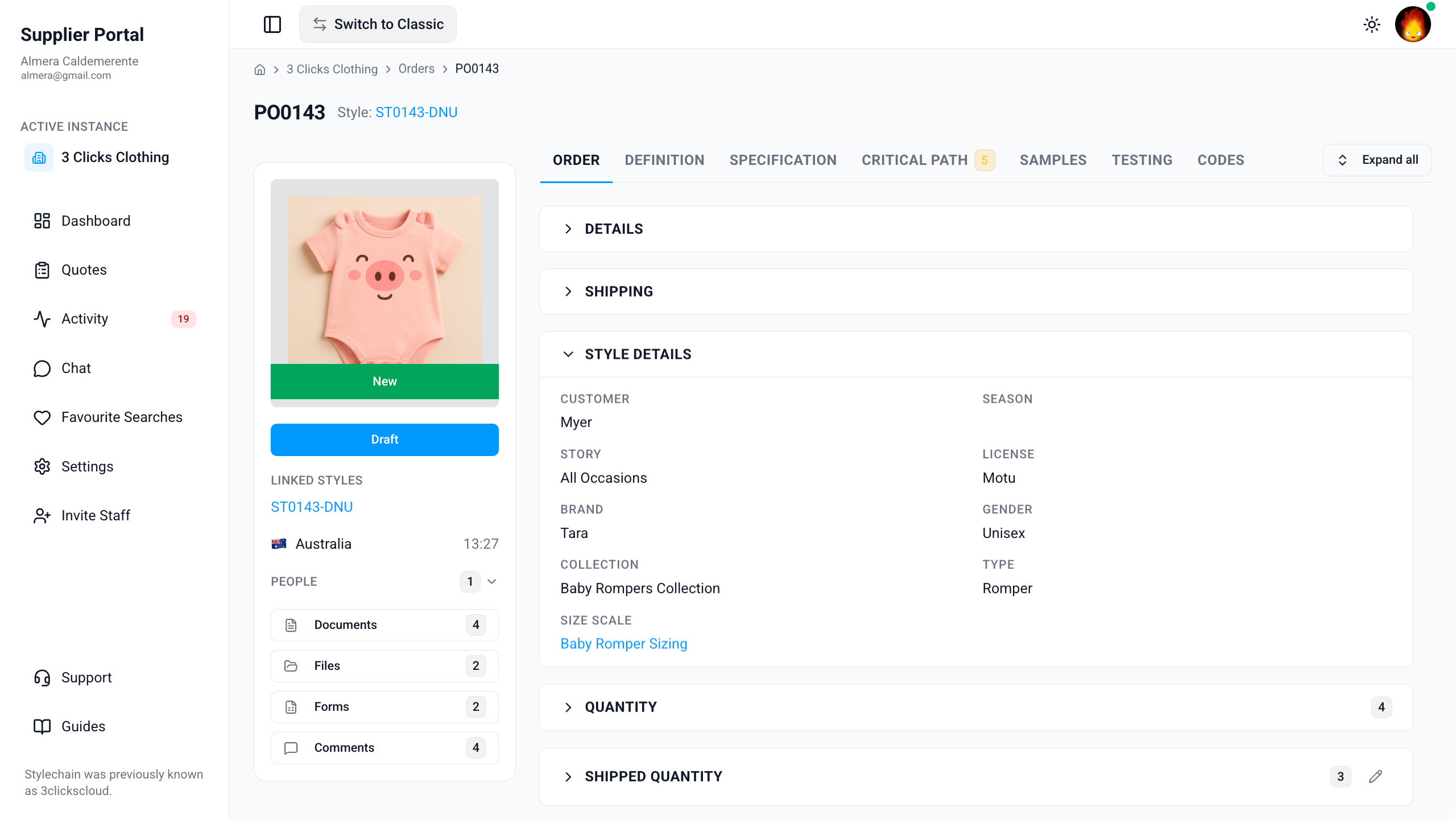
| Field | Description |
|---|---|
| Customer | The customer the order is placed for. |
| Season | The fashion season assigned to the style on the order. |
| Story | The theme or story behind the style. |
| License | Any licence associated with the style, when applicable. |
| Brand | The brand the style belongs to. |
| Gender | The target gender for the style. |
| Collection | The collection the style is grouped under. |
| Type | The product or style type. |
| Size Scale | The size scale used for sizing and grading on the order. |
Linked Style Records
When the linked style is also shared with your supplier account, open it from Linked Styles on the side widget for deeper product context — including Definition, Specification, Samples, and Critical Path tabs. See Supplier Portal › Style. You can also review the order-level bill of materials on Definition without leaving the order record.
Quantity
The Quantity section displays a view-only table of colourway quantities broken down by size. Instance users configure this data on Order › Colour Quantity & Pricing in the Production Portal.
Use this table to confirm which colourways, pack types, and size breakups you are expected to produce or ship before you commit to ex-factory dates or carton planning.
Supplier Portal > Orders > Quantity 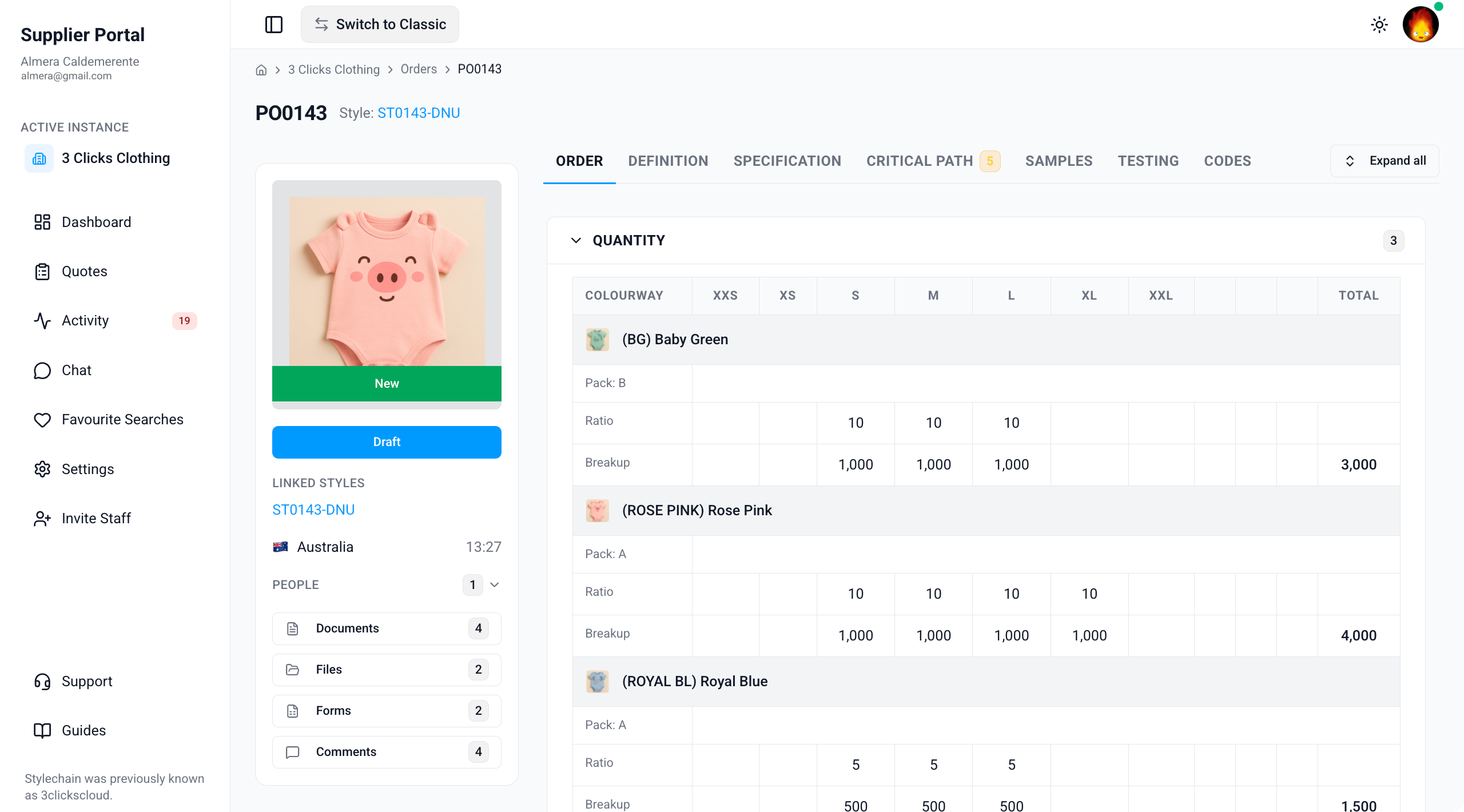
| Column / Row | Description |
|---|---|
| Colourway | The colourway name and preview image for each row. |
| Pack | The pack type applied to the colourway, when pack quantities are configured on the order. |
| Sizes | Size columns showing the quantity ordered for each size. |
| Ratio | The ratio breakdown per size when ratio packs are in use on the order. |
| Breakup per size | The calculated quantity allocated to each size based on the order configuration. |
| Total | The total quantity for the colourway across all sizes. |
Quantity Changes on the Customer Side
Instance users can add, edit, or remove colourway quantities in the Production Portal. If quantities change after you received a purchase order, review Activity for updates and raise a query through Comments or Chat if the portal data does not match your customer's latest communication.
Shipped Quantity
The Shipped Quantity section shows how much of the order has been dispatched and may allow you to enter shipped quantities when your customer has enabled supplier editing.
A summary line at the top of the section compares shipped and ordered totals — for example, Shipped 7,500 of 11,500 ordered — short ship — so you can see at a glance whether the order is fully shipped, partially shipped, or over-shipped.
Supplier Portal > Orders > Shipped Quantity 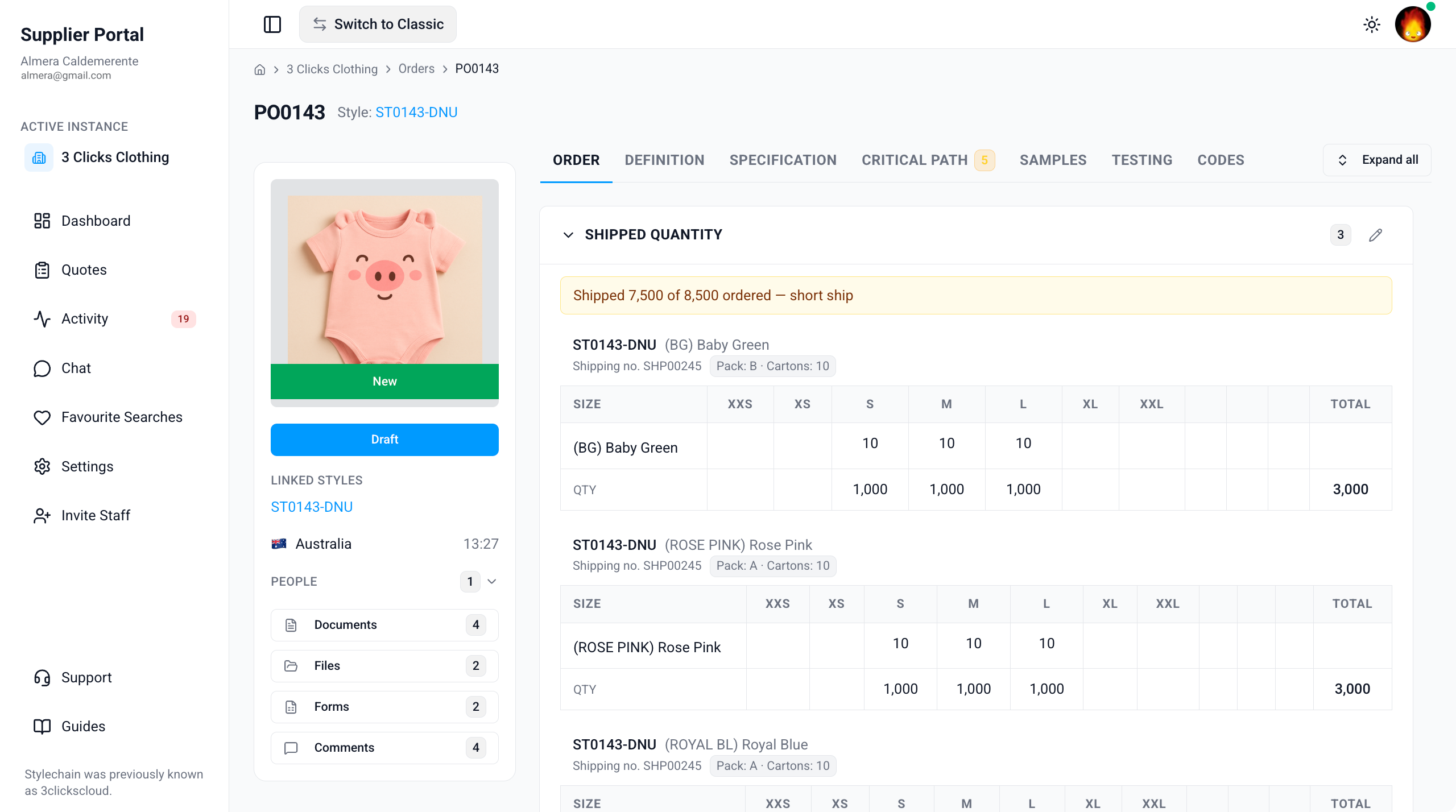
When editing is enabled, click the pencil icon on a row to update shipped quantities. Each entry typically includes:
Supplier Portal > Orders > Final Shipped Quantity 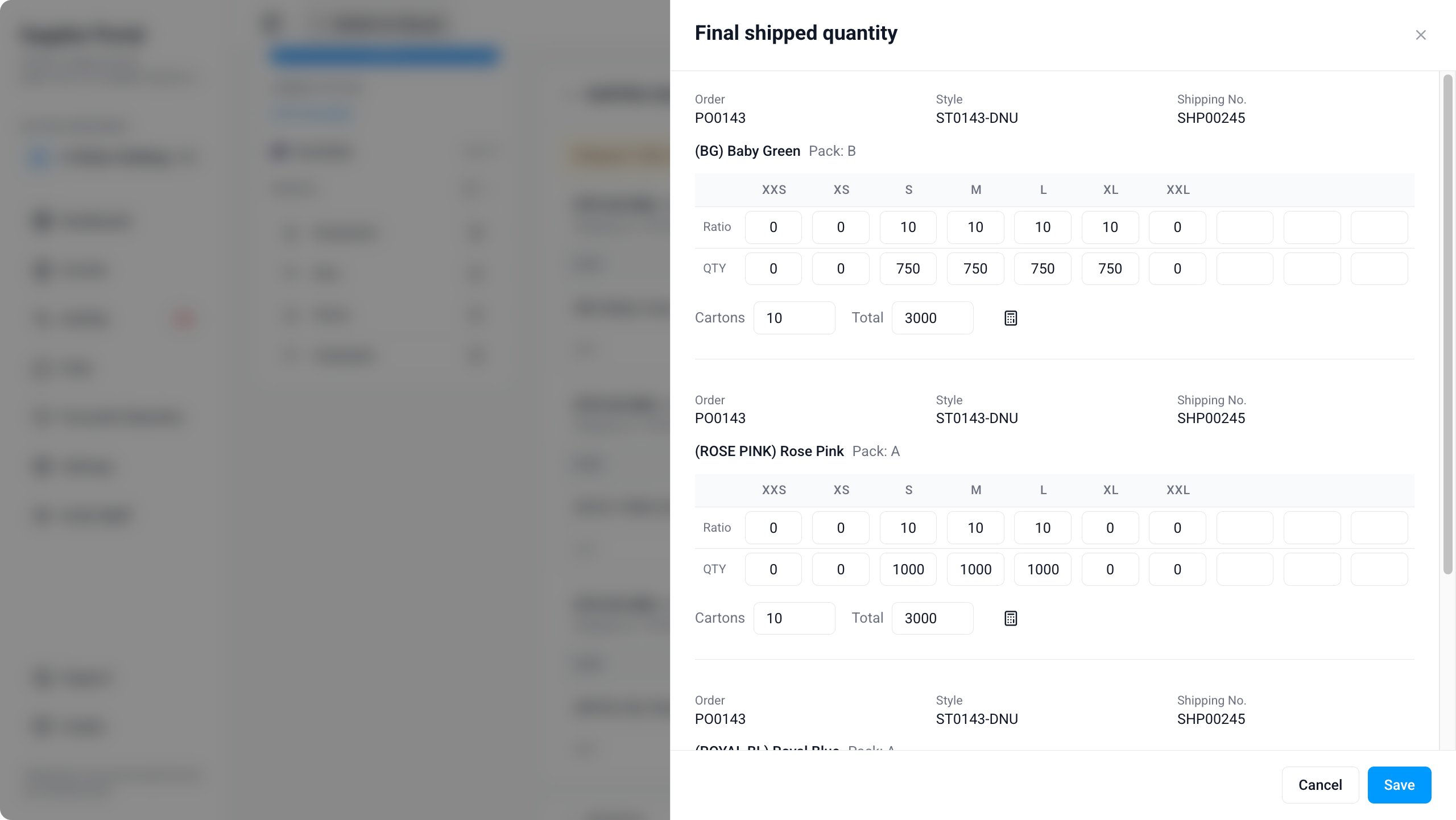
| Field | Description |
|---|---|
| Order No. | The order number the shipment line relates to. |
| Colourway | The colourway being shipped. |
| Shipping No. | The shipment or shipping reference linked to the dispatch. |
| Pack | The pack type for the shipped line, when applicable. |
| Cartons | The number of cartons recorded for the shipment line. |
| Sizes / Qty / Total | A breakdown of shipped quantity per size and the row total. |
Shipped Quantity Editing Is Controlled by Your Customer
If the Shipped Quantity section is missing or fields are read-only, your customer may have disabled supplier quantity entry in Site Settings › Shipping › General Settings › Shipped Quantity. Until editing is enabled, communicate dispatch quantities through Comments or Chat so instance users can update the order record.
Pricing
The Pricing section displays order-level pricing in a table format. Values reflect what your customer's instance users have entered on the order in the Production Portal.
Which price types you can see depends on your customer's Site Settings › Portal › General Settings › Order configuration. Some customers restrict buy or retail values to protect margin information.
Supplier Portal > Orders > Pricing 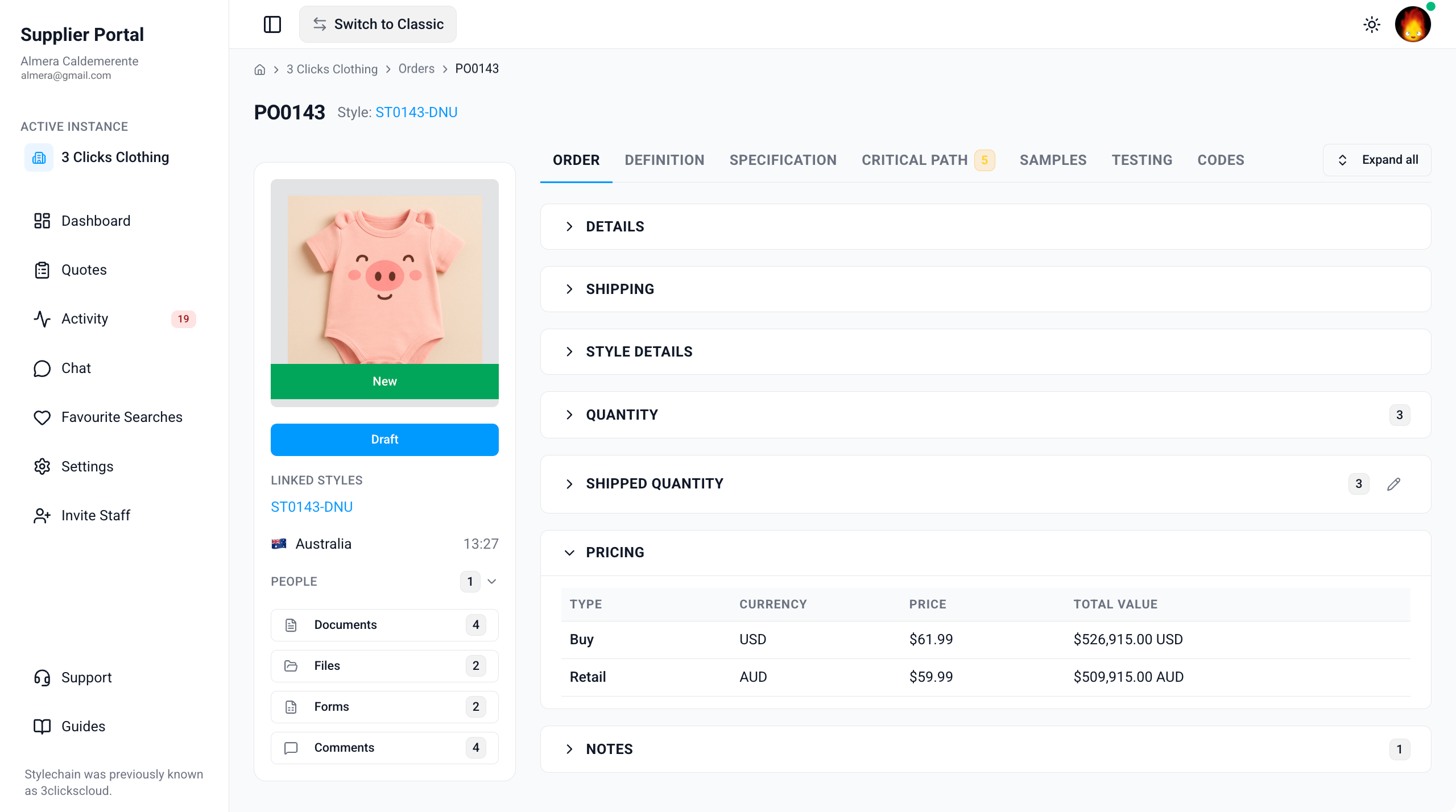
| Column | Description |
|---|---|
| Type | The price type for the row (for example, Buy or Retail). |
| Currency | The currency for the price shown on the row. |
| Price | The unit price value for the order. |
| Total Value | The total commercial value calculated from the order quantities and price. |
Pricing Visibility Is Controlled by Your Customer
If the Pricing section is empty or specific columns are missing, your customer may have restricted order pricing in Site Settings › Portal › General Settings › Order. Confirm expected commercial terms with your instance user contact rather than assuming a system error.
Where Pricing Comes From
Instance users maintain order pricing on Order › Colour Quantity & Pricing in the Production Portal. Buy and retail values flow from that section according to your customer's portal display rules.
Notes
The Notes section displays messages your customer's production portal users have posted on the order. Notes are view-only in the Supplier Portal — you can read them but cannot reply, edit, or add new notes on this section.
Use Comments on the side widget when you need to ask a question or respond to your customer's team. Instance users may mark some notes as private on the Production Portal; only notes intended for supplier visibility appear here.
Supplier Portal > Orders > Notes 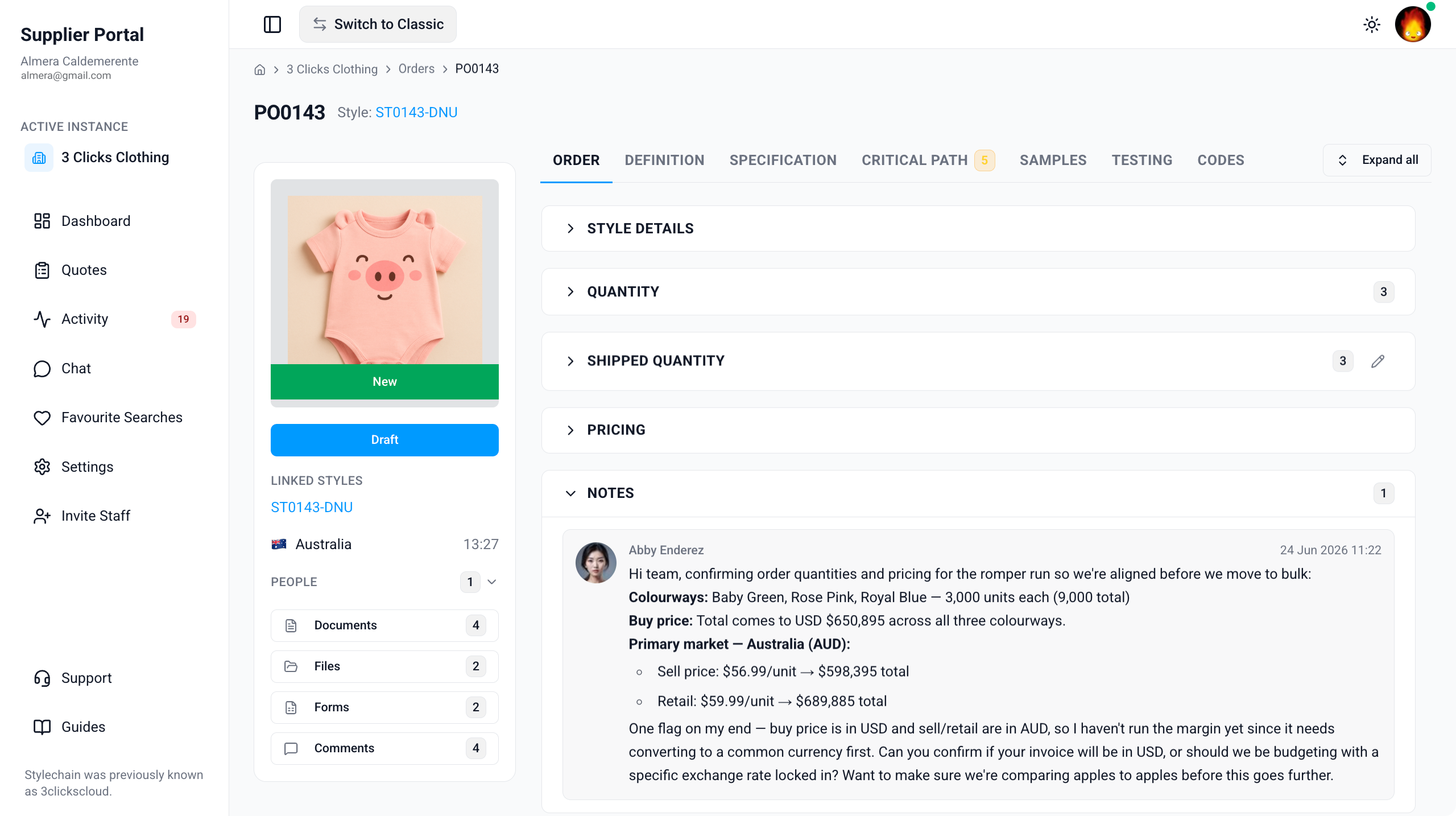
Sample Scenarios
Refer to these scenarios to understand how suppliers use the Order record in the Supplier Portal. Each scenario links to related documentation in this portal.
Scenario 1: Production planner confirming colourway quantities
A production planner opens a shared order to verify colourway breakups and total quantities before scheduling the line.
| Step | What to do | Related documentation |
|---|---|---|
| 1 | Open the order from Orders search or Activity and confirm the order number and Status on the side widget. | Supplier Portal › Orders |
| 2 | Review Details for Factory, ETD, Total Quantity, and Bulk. | Details |
| 3 | Check the Quantity table for each colourway, pack, size breakup, and Total. | Quantity |
| 4 | Download the Purchase Order or Specification from Documents when available. | Side Widgets |
| 5 | Ask questions through Comments if quantities do not match the brief. | Supplier Portal › Activity |
Scenario 2: Logistics coordinator recording shipped quantities
A logistics coordinator records partial shipment quantities against an order when the customer has enabled supplier shipped-quantity entry.
| Step | What to do | Related documentation |
|---|---|---|
| 1 | Open the order and review Quantity to confirm the full ordered breakup. | Quantity |
| 2 | Go to Shipped Quantity and check the summary line (for example, short-ship status). | Shipped Quantity |
| 3 | Click the pencil icon and enter shipped quantities per colourway, size, pack, and cartons. | Shipped Quantity |
| 4 | Cross-check Shipping for Origin, Destination, and Freight Status. | Shipping |
| 5 | If fields are read-only, post dispatch details in Comments for your instance user to update. | Side Widgets |
Scenario 3: Merchandiser reviewing style context and pricing
A merchandiser confirms brand, season, and commercial values on a shared order before an internal sign-off meeting.
| Step | What to do | Related documentation |
|---|---|---|
| 1 | Review Style Details for Season, Brand, Collection, and Size Scale. | Style Details |
| 2 | Open the linked style from Linked Styles when shared for fuller product context. | Supplier Portal › Style |
| 3 | Check Pricing for Type, Currency, Price, and Total Value rows. | Pricing |
| 4 | Read Notes for instructions posted by your customer's team. | Notes |
| 5 | Download reference files from Files or Documents for the meeting pack. | Side Widgets |
Next Steps
- Review sample requirements and reports on Samples
- Confirm SKUs, barcodes, and ticket details on Codes
- Track production milestones on Critical Path
- Review sketches, images, and measurements on Specification
- Review the order bill of materials on Definition
- Search and open shared orders
- Review linked styles
- Monitor order activity and notifications
- Download shared files from the Dashboard
- Configure order notifications
Related Settings
These Site Settings pages are maintained by your customer's administrators. Share them with your instance user contact if order visibility, pricing, or shipped-quantity editing does not match expectations.
- Site Settings › Company › Suppliers
- Site Settings › Order › General Settings
- Site Settings › Portal › General Settings
- Site Settings › Shipping › General Settings
Troubleshooting
Why can I open an order but not see Details, Quantity, or Pricing?
Section visibility depends on your Supplier Portal role, portal display settings, and what your customer has shared on the order record.
Steps to resolve:
- Confirm whether the section is missing entirely or visible but empty.
- Ask your instance user to verify your Supplier Portal role in Site Settings › Company › Suppliers includes Order with View enabled.
- Ask them to confirm the order is assigned to your factory or agent and that quantities and pricing exist on the Production Portal record.
- Click Refresh or reopen the order from Activity after your customer confirms updates.
Why is the Pricing section empty or missing price types?
Order pricing visibility is controlled by your customer in Site Settings › Portal › General Settings. Restricted pricing is intentional in many workflows.
Steps to resolve:
- Confirm with your instance user whether buy or retail pricing should be visible to your supplier role.
- Ask them to review Order pricing toggles in Site Settings › Portal › General Settings.
- Check whether pricing is entered on the order in the Production Portal.
Why can I not edit Shipped Quantity?
Supplier shipped-quantity entry is controlled by your customer in Site Settings › Shipping › General Settings › Shipped Quantity. When the setting is disabled, the section may be hidden or read-only in the Supplier Portal.
Steps to resolve:
- Confirm whether Shipped Quantity appears but fields are greyed out, or the section is missing entirely.
- Ask your instance user to review Shipped Quantity settings if you are expected to record dispatch quantities in the portal.
- Until editing is enabled, communicate shipped quantities through Comments or Chat.
Why do quantities not match the purchase order I received by email?
Order quantities are maintained by instance users on Order › Colour Quantity & Pricing in the Production Portal. Quantities may change after an earlier purchase order was sent.
Steps to resolve:
- Refresh the order record and review Activity for recent quantity updates.
- Compare the Quantity table colourway, pack, and size breakups with your customer's latest communication.
- Contact the instance users listed under People on the order card to confirm the current approved quantities.
Why can I not click a style in Linked Styles?
Linked Styles entries are only clickable when that style is also shared with your supplier account on the same customer connection.
Steps to resolve:
- Confirm the style number matches what your customer referenced on the order.
- Ask your instance user to share the linked style with your factory or agent if you need full style tabs.
- Use Style Details on the order for read-only merchandising context when the style record is not shared separately.
Why can I reply in Comments but not in Notes?
Comments and Notes serve different purposes on the order. Comments support two-way collaboration with your customer's team. Notes are written by instance users on the Production Portal and are displayed read-only to suppliers.
Steps to resolve:
- Use Comments for questions, clarifications, and shipment updates.
- Read Notes for instructions or context your customer has chosen to share with suppliers.
- If you expected a note to appear, ask your instance user to confirm it was posted as a supplier-visible note on the Production Portal.
Why can I not download a document or file from the order?
Documents and Files only include outputs and uploads your customer has shared with your supplier account.
Steps to resolve:
- Confirm the Documents row or Files folder exists on the order — if it is missing, the document may not have been generated or shared yet.
- Ask your instance user to generate the Purchase Order, Specification, or other document on the Production Portal and confirm file sharing settings.
- Check the Dashboard for files shared at the customer level if the file is not attached to the individual order.
Why do I not appear under People on the order card?
People lists instance users — your customer's internal team members assigned to the order — not supplier portal users.
Steps to resolve:
- Use Comments or Chat to reach your customer's team; supplier staff are not listed in People.
- Ask your instance user contact which internal owner manages the order if you are unsure who to message.
- Ensure your own team has portal logins via Invite Staff so multiple supplier users can access the shared record.